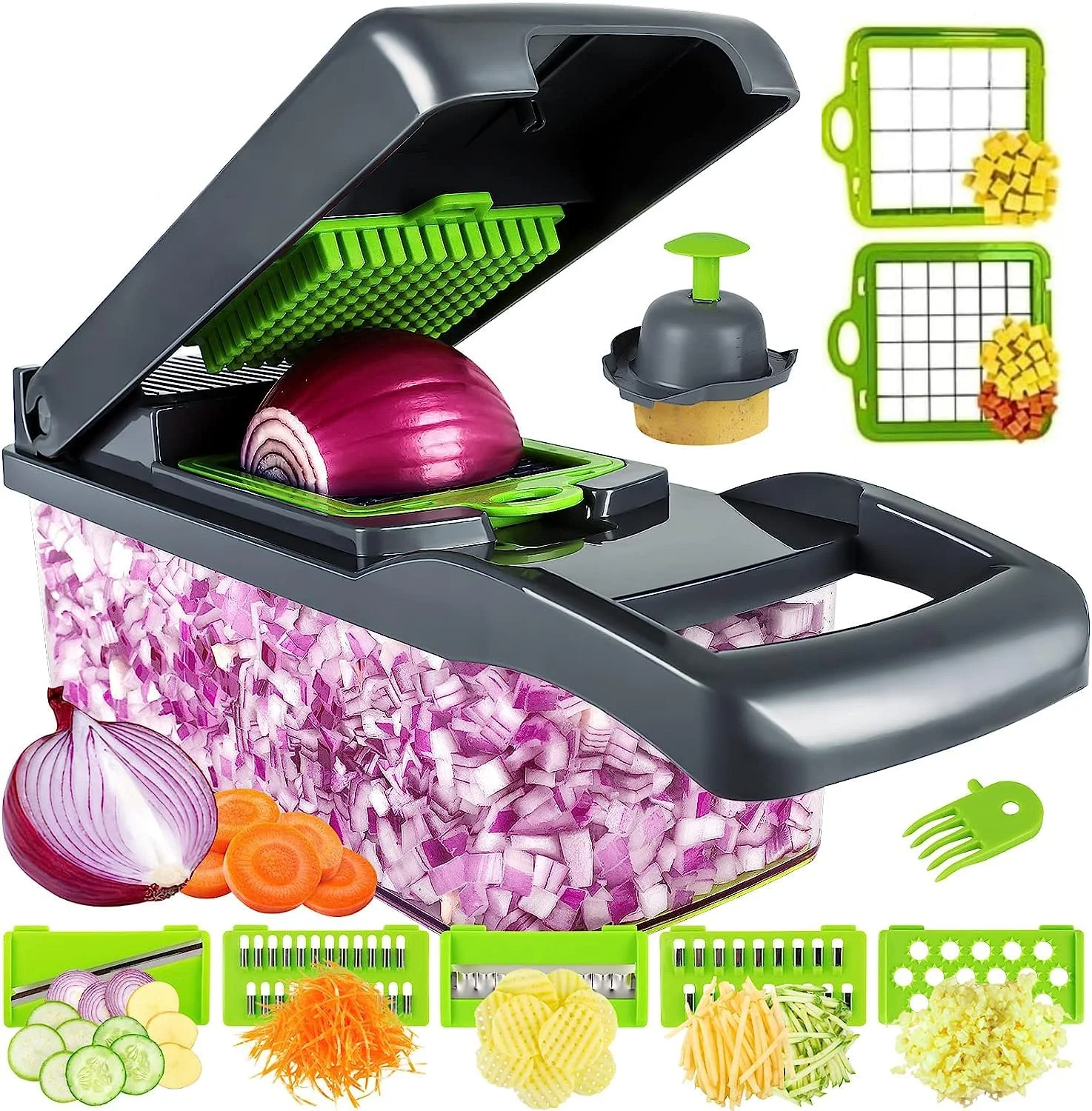
If you chop onions, tomatoes, chillies and coriander every day, the right chopper can take a real chunk out of your prep time. In short: a manual chopper with interchangeable blades suits people who want neat slices, grating and dicing without charging anything, while a small electric chopper suits people who mostly want fast, rough chopping of small quantities.
This guide explains the difference, what to look for in blades and capacity, how to clean a chopper without nicking your fingers, and which options on Insta Top Picks fit different kitchens.
Manual vs electric: which chopper is better?
Neither type is better for everyone. They solve slightly different problems, so start by thinking about what you cut most often and how much of it.
Manual choppers and slicer sets
Manual choppers come in two broad styles. Pull-cord or press choppers chop food inside a closed bowl. Slicer sets, sometimes sold as “multipurpose” or “14 in 1” kits, use a container with a set of flat blades that you press or slide food across, so you can switch between slicing, julienne strips, grating and dicing.
- Strengths: no battery or socket needed, more control over the shape of each cut, and usually more cutting styles in one box.
- Limitations: they need your effort, there are more separate parts to wash and store, and flat blades need careful handling.
Electric (rechargeable) choppers
Compact electric choppers have a motor, a small bowl and a spinning blade. You add food, press a button and let it run for a few seconds. Some handheld models also take slicing or grating attachments.
- Strengths: very quick for garlic, ginger, chillies, onions and small batches of chutney-style mixes, and they need little effort, which helps if you have wrist or grip discomfort.
- Limitations: bowls tend to be small, results are less even than a slicer, the battery needs charging, and the motor housing must be kept away from running water unless the maker says otherwise.
A quick way to decide
- You want uniform slices for salads, chips or garnishes: lean towards a manual slicer set.
- You mostly mince garlic, ginger and chillies for tadka or masala: a small electric chopper is the faster fit.
- You cook in large quantities for a family: look for a bigger container, or plan to chop in batches.
- Your counter has no spare socket and you dislike charging gadgets: manual is simpler.
Which blade material lasts longest?
For home choppers, stainless steel is the standard choice. Several of the products below name 420 stainless steel, a hardenable grade that is widely used for cutting edges because it can be made harder than common kitchen-utensil grades. That helps it keep an edge, while the chromium content helps it resist rust.
No blade stays sharp for ever, and how you treat it matters as much as the grade:
- Rinse blades soon after use, especially after cutting acidic foods such as tomato, lemon or tamarind.
- Dry them fully before storing. Leaving blades wet in a closed box is a common cause of spotting.
- Do not use choppers on bones, frozen food or very hard whole spices unless the product information says it can handle them.
- Store spare blades in their own box so the edges do not knock against each other.
Also look at what the body is made of. A container described as food-grade or BPA-free plastic is what you want for something that touches food every day. Check that the lid and container feel firm, because a flexing lid can let blades sit out of line.
Capacity, size and storage
Bowl and container size decide how many rounds you will need. A small 250 ml electric bowl is ideal for a few cloves of garlic or one onion, but you will need several rounds for a full family meal. Larger manual containers can hold more sliced or grated food before you need to empty them.
Storage matters just as much in a compact Indian kitchen. Before you buy:
- Count the parts. Multi-blade sets are versatile, but every blade needs a home.
- Prefer sets with a dedicated blade storage box, so blades are not loose in a drawer.
- Measure the cupboard or shelf where it will live, and check the product dimensions against that space.
- For electric models, note where you will charge it and how long the charging cable is.
How do you clean a chopper safely?
Most chopper injuries happen while washing, not while chopping. A few habits keep cleaning safe and quick:
- Unplug or switch off first. For electric models, make sure the unit is off and not charging before you touch the blade.
- Take it apart. Remove blades and inserts so food does not stay trapped under them.
- Use a brush, not your fingers. Many sets include a cleaning brush or a small claw for clearing blade grids. If yours does not, a soft bottle brush works.
- Keep motors dry. Wash only the parts the manufacturer says can go in water. Some electric choppers say the bowl can be rinsed under the tap or used with a “one-touch” rinse, but the charging port and motor base still need protecting.
- Check dishwasher advice per part. A listing may say some parts are dishwasher safe. Follow the manual for each piece rather than assuming the whole kit is.
- Dry and store. Air-dry or towel-dry blades and put them back in their storage box.
This is general information, not safety advice for a specific product. Always read and follow the manufacturer’s instructions for charging, cleaning and blade handling, and keep blades and electric choppers out of children’s reach.
Products worth considering
These choppers are listed in our kitchen accessories section. The notes below are based on the published product information, not on our own testing. You can read how we shortlist items in How We Choose Products.
14 in 1 Multipurpose Chopper, Fruits & Vegetable Cutters, Grater Peeler Chipser
This is a manual slicer-and-dicer kit built around a large container and a set of swappable blades. It is aimed at people who want one tool for several cutting styles, from dicing onions to shredding and grating. The kit also adds a few cleaning extras, which matters with this many blades.
Good to know:
- Listed with 8 interchangeable blades made from 420 stainless steel.
- Comes with a blade storage box and two cleaning brushes. The listing also mentions a claw for clearing residue.
- Includes an egg white separator and a push-to-clean button, according to the listing.
- Consider: many separate parts, so set aside drawer or shelf space for the full kit.
See details and buying options
Multi Purpose Vegetables Chopper with Strainer
Another manual, multi-blade design, but with a drain basket built into the container so you can rinse and drain vegetables in the same unit. Its blades cover slicing, julienne and grating, which makes it handy for salads, vegetable “noodles” and garnishes.
Good to know:
- Interchangeable blades for slicing, julienne strips and grating, with a storage box for them.
- Integrated strainer/drain basket that attaches with a rotating snap.
- Described as BPA-free material, with food-grade 420 stainless steel blades and a hand protector.
- Consider: as with any mandoline-style blade, always use the hand guard rather than bare fingers.
See details and buying options
4 in 1 Handheld Portable Wireless Electric Vegetable Cutter
A cordless, handheld electric cutter that charges by USB and takes different attachments for chopping, slicing, grating and shredding. It suits quick jobs such as garlic slices and chilli rings that go straight into the pan.
Good to know:
- Four functions: chop, slice, grate and shred, using interchangeable attachments.
- Wireless, with charging through an included USB cable.
- A feeding hole lets you push in long items such as chillies or beans without opening the lid.
- A safety lock is described as stopping it running unless the lid is locked in place.
- Consider: check how long a charge lasts in the product information, and keep the charging point dry.
See details and buying options
Electric Mini Fruit-Vegetable Chopper / Cutter
A compact, rechargeable mini chopper with a 250 ml bowl and one-button control. It is meant for small batches of vegetables, fruit, garlic, nuts and spices, and is a sensible choice for a small household or for anyone who mainly wants fast mincing.
Good to know:
- USB rechargeable with a built-in battery, so it can be used away from a socket.
- 250 ml bowl with food-grade stainless steel blades and BPA-free material.
- One-button operation. The listing says the bowl and blades are removable and can be washed.
- Consider: the small bowl means several rounds for larger family meals.
See details and buying options
Side-by-side comparison
| Product | Main features | Best suited for | Things to check |
|---|---|---|---|
| 14 in 1 Multipurpose Chopper | Manual; 8 interchangeable 420 stainless steel blades; blade box; cleaning brushes | Varied slicing, dicing and grating without power | Storage space for all parts |
| Multi Purpose Vegetables Chopper with Strainer | Manual; slicing, julienne and grating blades; built-in drain basket; hand protector | Salads and prep where you rinse and cut in one place | Always use the hand guard |
| 4 in 1 Handheld Wireless Electric Cutter | USB rechargeable; chop, slice, grate, shred; feeding hole; safety lock | Quick garlic, chilli and small slicing jobs | Charge time and battery life |
| Electric Mini Fruit-Vegetable Chopper | USB rechargeable; 250 ml bowl; one-button; BPA-free | Small batches, mincing garlic, ginger and nuts | Bowl size for your family |
How to choose: a short checklist
- Match the tool to your most common task. List the three things you cut most each week. If they need neat shapes, go manual. If they need mincing, go electric.
- Check blade information. Look for named stainless steel blades and a safe way to store spares.
- Look at the materials touching food. Food-grade or BPA-free plastic is the baseline.
- Think about cleaning before buying. Fewer crevices and a brush or tool for the blade grid make daily washing easier.
- For electric models, check the power details. Charging method, how long a charge lasts and whether any part can go under water.
- Plan the storage spot. A tool you have to dig out of the back of a cupboard tends not to get used.
Frequently asked questions
Can a vegetable chopper replace a knife completely?
Not usually. Choppers are great for repetitive jobs such as onions, garlic and grated vegetables, but you will still want a good knife for large items, trimming and leafy greens.
Can an electric mini chopper make chutney or paste?
Small electric choppers are designed for chopping and fine mincing. For smooth, wet chutneys and pastes, a mixer grinder is the better tool. Check the product information before adding liquids.
Why does my chopper smell of onion or garlic?
Residue trapped under blades or in lid seals is the usual cause. Take the parts apart after each use, wash with warm soapy water, and let everything dry fully before reassembling.
Are electric choppers safe to wash under the tap?
Only the parts the maker says are washable. Some models describe the bowl or attachments as water-safe, but the motor and charging port should be kept dry unless the manual clearly says otherwise.
Final thoughts
If you want variety and control and do not mind a few extra parts, a manual multi-blade chopper is the more flexible buy. If your main goal is to mince garlic, ginger and chillies quickly in small amounts, a compact rechargeable chopper will save the most effort. Whichever you choose, check the blade material, capacity and cleaning instructions first. For more ideas, browse our kitchen accessories.